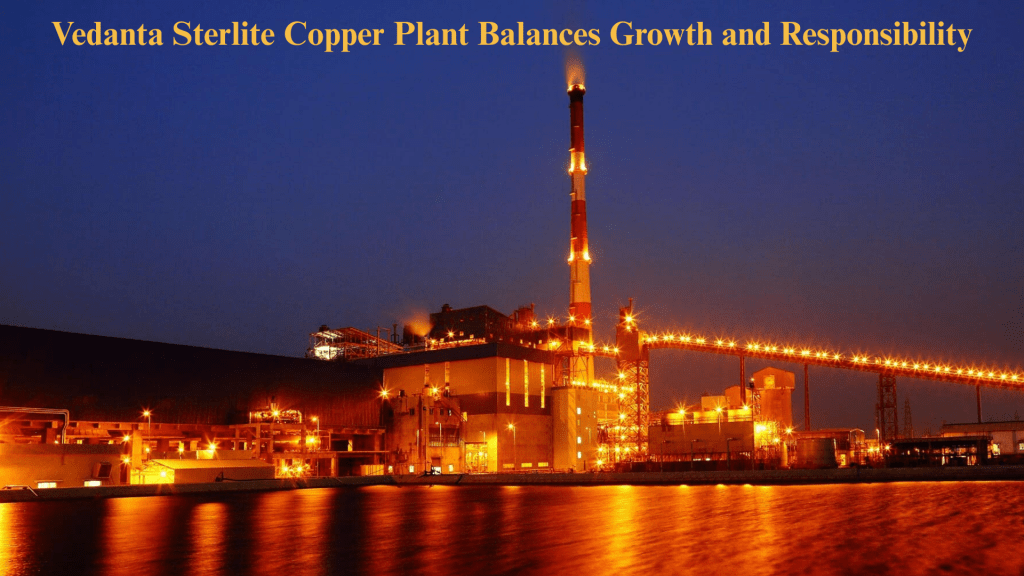
India’s journey toward becoming a global manufacturing and green energy hub depends majority on one of the strategic resources—copper. With industries such as electric mobility, solar energy, and telecommunications growing significantly, the country’s copper needs are also expected to double in the coming decade. In this context, Vedanta Sterlite copper plant in Tuticorin, Tamil Nadu, marks a significant step toward helping India achieve its copper goals. For years, the plant played an important role in strengthening India’s supply chain. However, it was closed in 2018.
Surging demand for copper also makes Vedanta Sterlite Copper’s comeback a matter of national importance and a strategic step toward national self-reliance, sustainable growth, and economic empowerment.
A Strategic Asset for Self-Reliance
Before its closure, Vedanta Sterlite supplied a large portion of India’s copper demand. However, the plant’s shutdown increased India’s import dependence and widened trade deficits. Before closure, the plant contributed 36% of the country’s copper needs, generated INR 13,500 crore for the exchequer (FY14 – FY18), and supported 4,000 direct and 20,000 indirect jobs.
But now a group of advocates is urging the state government to reopen the Sterlite Copper unit, which was shut by the Tamil Nadu Pollution Control Board (TNPCB). The protestors say the plant, when operational, provided “direct and indirect employment to several thousand workers while implementing social-security schemes in the adjoining villages.”
By resuming operations at Vedanta Thoothukudi, the company will not just strengthen India’s goal of achieving Atmanirbhar Bharat but will also be able to empower the locals through direct and indirect jobs.
Commitment to Responsible Operations
Vedanta has assured full compliance with environmental norms and has implemented green process technologies to minimise ecological impact. The focus will be on:
- Zero-liquid discharge and advanced waste recycling systems.
- Continuous emissions monitoring.
- Renewable energy integration to power operations.
- Transparent data-sharing with local authorities and communities.
- This responsible approach reflects the company’s larger vision of merging industrial scale with environmental ethics.
Driving India’s Clean Energy Transition
Copper plays a central role in electric vehicle wiring, power grids, and renewable energy systems. With global copper demand expected to surge 60% by 2035, Vedanta Sterlite’s contribution will be pivotal in enabling India to meet its net-zero and energy independence goals.
Even a two-member expert committee has been formed, and they suggested a “green restart” of the Sterlite Copper smelter plant. The restart is crucial for Vedanta Resources, the parent company of Vedanta, which is in the middle of an elaborate restructuring exercise that is facing headwinds in different areas. The expert committee has suggested a hybrid production model, which would see 30% of the copper produced through recycling, reducing slag generation by 15% and hazardous waste by 40%
Key Elements of Green Start
The hybrid production model is expected to significantly reduce the environmental impact. The usage of recycled copper would also minimise the need for copper-concentrate processing- the main source of slag generation in smelting operations. Other key elements of green restart include:
- Hydrogen Production Model: Vedanta Sterlite Copper plant will adopt 70% primary smelting and 30% recycled copper to reduce slag (15%) and hazardous waste (40%).
- Emission Controls: Plans include increasing stack height to 68 meters and upgrading gas capture systems to reduce emissions and ETP load.
- Sustainability Initiatives: As per the Green Start drive, Vedanta will expand its green efforts. It will expand tree planting, restore water bodies, and increase desalinated water use to 80%, achieve 100% water recycling, and use municipal wastewater.
- Community Engagement: Establish a local management committee with diverse stakeholders and use corporate social responsibility (CSR) funds for education, healthcare, women’s empowerment, and local development
To ensure utmost transparency and community welfare, Vedanta Sterlite reopening would include the establishment of a local management committee consisting of the community, panchayat, and plant representatives. The committee also suggested creating an INR 100 crore corpus with CSR funds for schools, hospitals, women and youth skilling, and environmental improvements.
Conclusion
Vedanta Sterlite’s return is more than an industrial decision; it’s a national milestone. It embodies India’s transition from dependency to self-sufficiency, from conventional mining to green manufacturing. Indeed, Sterlite Copper’s Green Restart is a transformative model of responsible industrialisation backed by sustainability, circular economy, and community engagement.
With Vedanta adopting a more responsible, forward-looking approach, its copper plant stands poised to lead India into an era where industrial growth and environmental stewardship advance hand in hand.
 Vedanta Case
Leave a comment